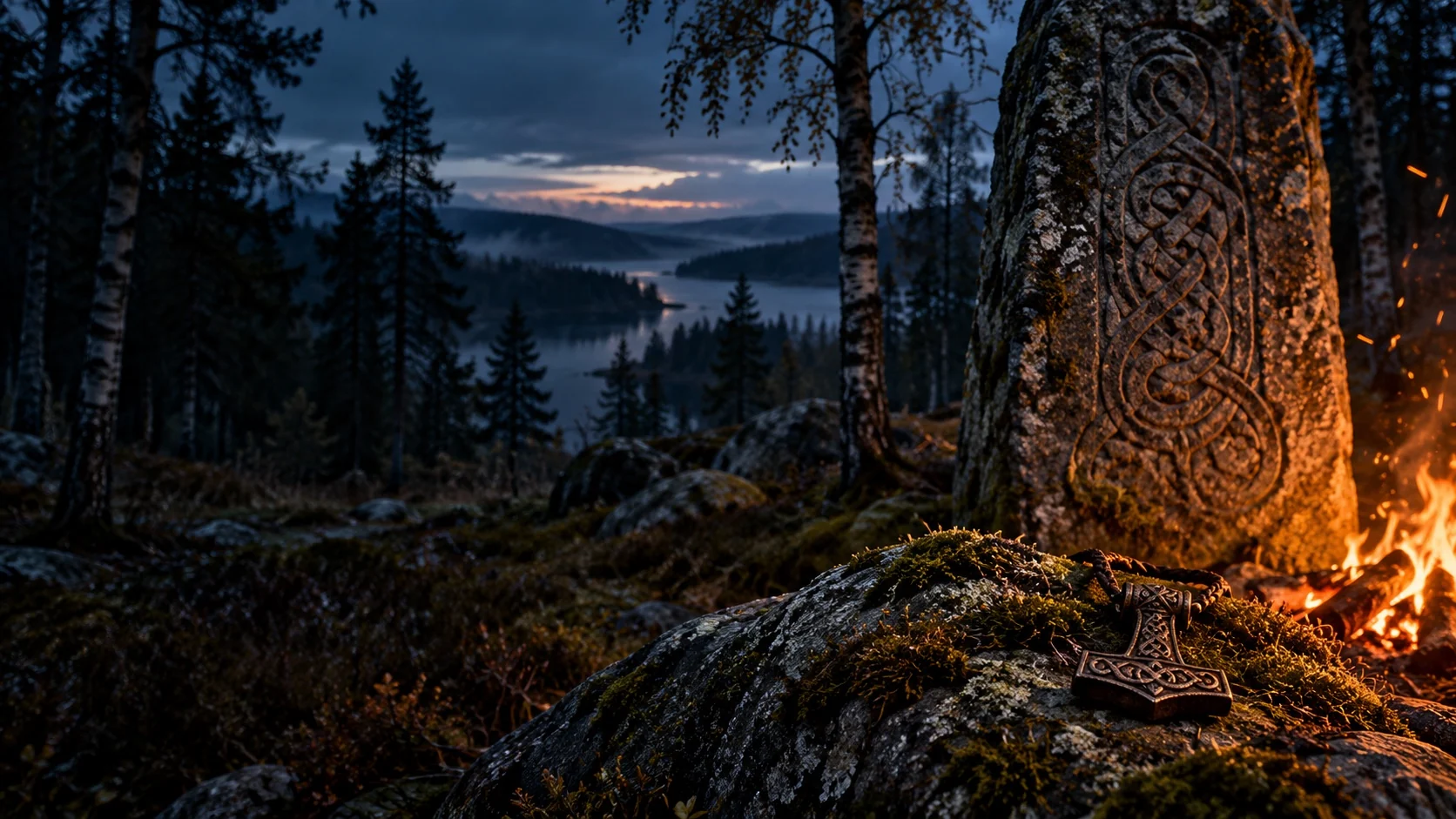
Religion shaped hopes about the harvest, protection, power and life after death. Beliefs changed over time, and varied between communities.
BELIEFS IN EVERYDAY LIFE
Explore a world of belief.
MANY GODS, LOCAL TRADITIONS
Belief was part of daily life.
Before Christianity became dominant, Scandinavian people worshipped many gods. Stories connected Odin with wisdom, war and magic, and Thor with thunder and his hammer. Freyr and Freyja were associated with fertility. Religion concerned everyday hopes as well as powerful stories: a successful harvest, healthy animals, protection and family life. Small hammer pendants show how beliefs could be worn on the body.
We must be careful when reconstructing these beliefs. Much of the surviving written mythology was recorded in Christian Iceland in the thirteenth century, long after the Viking Age. Local practices may have differed from those later stories. Archaeology and contemporary inscriptions help us compare the evidence.
Source question: If a story was written down centuries later, how might the writer’s own beliefs have shaped the version we read?
CONTINUITY & CHANGE
A gradual transformation.
Harald’s larger Jelling stone announced a royal Christian identity in the late tenth century. A king’s public statement did not instantly change everyone’s beliefs. Contact through travel, trade and missionaries helped spread Christianity, while older practices continued.
Some animal decoration from Scandinavian traditions remained in Christian art. This is continuity and change: new ideas could develop alongside familiar customs.
The Viking Ship Museum links royal conversion with relationships beyond Scandinavia. Its interpretation suggests Christianity could help kings negotiate power with neighbouring Christian rulers. That explains one possible political motive; it does not let us read a ruler’s private thoughts.
834 AD (burial) Oseberg farm near Tønsberg, Vestfold, Norway; discovered in 1903 and excavated in 1904
Archaeological burial assemblage: ship, human remains and grave goods
PRIMARY SOURCE / Social status
The Oseberg ship burial
What it reveals & why it helps
Two women were buried with a ship, carved wooden objects, textiles, furniture and kitchen equipment. The costly funeral suggests that one or both held considerable status, while the objects reveal skilled craftwork and material aspects of daily life. Goods placed with the dead also help historians investigate burial customs and ideas about an afterlife. Its unusually good preservation makes Oseberg especially useful.
Limits & questions
However, this lavish burial cannot represent every household. The women's identities remain unknown, and later grave robbing disturbed the evidence. Calling either woman a named queen would go beyond what the find establishes.
Late 10th century AD Jelling, central Jutland, Denmark; raised by King Harald Bluetooth in memory of his parents
Runestone: contemporary royal inscription and carved imagery
PRIMARY SOURCE / Kingship
Harald Bluetooth's larger Jelling stone
What it reveals & why it helps
Harald's inscription commemorates his parents and claims authority over Denmark and Norway and the conversion of the Danes to Christianity. Its image of Christ connects a ruler's public message with religious change. The stone is valuable contemporary evidence for royal ambitions, family remembrance and the use of runes.
Limits & questions
Yet a king commissioned it to celebrate his achievements, so it presents his perspective. It cannot prove that every community accepted his rule or that everybody changed belief at once. Read alongside other finds, it helps explain a gradual transformation in Scandinavian power and religion.
First half of the 9th century, c. 800–850 AD Ribe, Denmark; excavated during the 2017–2018 campaigns
Personal object bearing a runic inscription
PRIMARY SOURCE / Everyday life
Ribe's runic antler comb
What it reveals & why it helps
A fragmentary antler comb from Ribe carries runes on both sides, including the word for comb. This small object connects grooming and skilled manufacture with writing in a Viking trading town. Unlike a royal monument, it shows runes on something people could handle in everyday life. Specialists can compare its letters and language with other dated finds to study changes in writing.
Limits & questions
Its limits matter: one inscribed object does not show that everyone could read, identify its owner or explain why the words were carved. Those questions require further evidence.
c. 750–980 AD (the trading town's main period) Björkö island in Lake Mälaren, Sweden; associated royal centre at Hovgården on neighbouring Adelsö
Archaeological settlement, harbour, cemeteries and excavated objects
PRIMARY SOURCE / Trade
Birka's settlement and cemetery remains
What it reveals & why it helps
Birka preserves evidence of a trading settlement, harbour, defences and cemeteries. Everyday utensils, craft remains and goods from distant places help reconstruct work, consumption and exchange in Viking-Age Sweden. Considering the town together with nearby Hovgården also connects trade with royal organisation. Its abandoned settlement is especially valuable because later building has not covered the ancient town.
Limits & questions
However, UNESCO reports that less than one per cent of the wider property has been excavated. The surviving sample is incomplete, and a commercial centre cannot automatically stand for the experience of rural Scandinavian families.
8th–11th centuries AD Schleswig isthmus on the Jutland Peninsula, now northern Germany; a Viking-Age centre in the Danish border region
Archaeological trading settlement: buildings, roads, harbour deposits, ships and objects
PRIMARY SOURCE / Trade
Hedeby's town and harbour remains
What it reveals & why it helps
Roads, buildings, cemeteries, harbour jetties and shipwrecks reveal the infrastructure behind a busy trading town. Imported objects and unusually well-preserved organic material help historians examine craftwork, exchange and connections between Scandinavia and continental Europe. Nearby defences also connect commerce with the control of routes and territory. These remains give material evidence for activities that written accounts may overlook.
Limits & questions
However, about 95 per cent of the town remains unexcavated, according to UNESCO. Its borderland location and commercial role make it a distinctive community, so findings should be compared with rural sites before generalising.
Aarhus University, School of Culture and Society English course published 2023; page revised 8 October 2026
SECONDARY SOURCE / CHANGE OVER TIME
3. Economy
Modern scholars interpret and connect evidence from the past. The article is secondary; the ancient coins and weights it discusses are primary evidence.
Analysis & usefulness
This modern university account explains how trade and payment changed. Early towns gathered skilled craftspeople and connected distant regions. Outside towns, weighed silver became important during the ninth century. Coins became more widespread, but did not immediately replace hacksilver; a controlled Danish coin system developed gradually after the Viking Age. The account is useful because it connects finds such as weights, hoards and coins to wider social change.
Limits & perspective
Its main limitation is geographical: it focuses on Denmark, so its sequence should not automatically be applied to Norway and Sweden.
Viking Ship Museum, Roskilde No publication date stated; accessed 27 October 2026
SECONDARY SOURCE / CHANGE OVER TIME
Christianity and foreign politics
Museum educators explain what earlier texts and objects might mean. Their interpretation is a modern secondary source, rather than an eyewitness account.
Analysis & usefulness
This museum explanation links religious change to political relationships. It suggests Harald Bluetooth’s conversion helped limit interference by Christian rulers to Denmark’s south. Later, Danish kings strengthened connections with the English Church and sought greater independence from Hamburg-Bremen. This is useful because it shows that conversion affected royal power and foreign contacts, as well as personal belief.
Limits & perspective
However, Harald’s private motives cannot be known directly, so the political explanation remains an interpretation. The article also centres on kings and Denmark, giving less space to ordinary people and regional differences.