Jarls
Jarls were nobles and powerful leaders. Land, wealth and followers gave them influence. Kings ruled above other leaders, although their authority depended on support.
TOUR STOP / 02
Life involved fields, families and skilled work. Your wealth, freedom and family connections shaped the choices you could make.
WORK & HOME
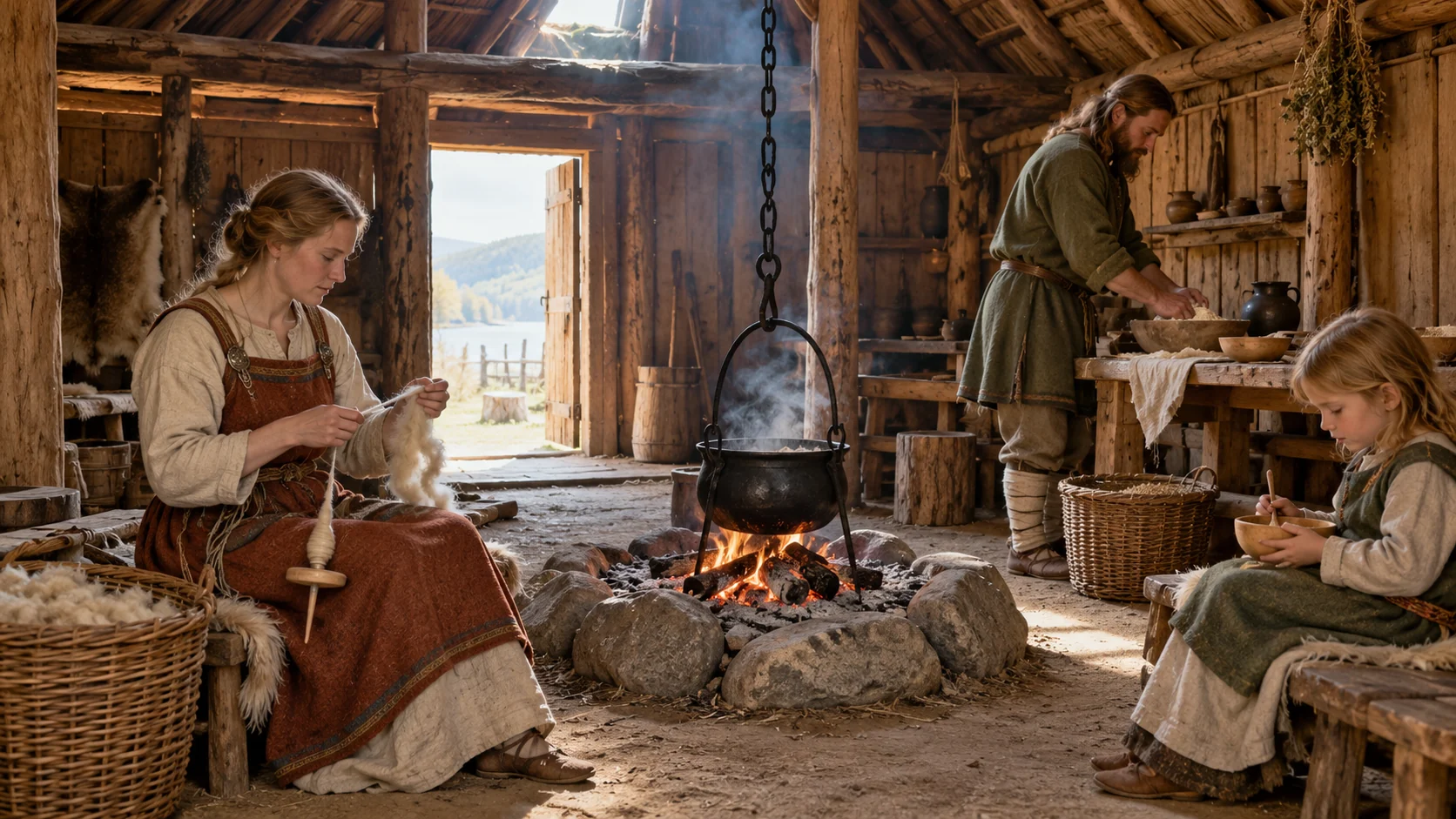
Spinning and weaving turned wool into useful textiles. The objects preserved at Oseberg reveal skilled craftwork and the material details of daily life.
WORK & HOME
For many people, daily life centred on a farm. Households grew food, kept animals and worked together. Land, family connections and wealth shaped a person’s opportunities. Kings and chieftains stood above most householders, but even free families could differ greatly in wealth. Leaders depended on networks of supporters rather than a modern government.
Longhouses brought people and everyday tasks under one roof. Wooden buildings, cooking hearths, food production and textile work shaped domestic life. Archaeological evidence helps us reconstruct these settings, although homes varied by place and resources.
SOCIAL STRUCTURE
These three groups are a useful starting point. They were not fixed, identical categories across every Scandinavian community.
Jarls were nobles and powerful leaders. Land, wealth and followers gave them influence. Kings ruled above other leaders, although their authority depended on support.
Karls were free people, including farmers, craftspeople and merchants. They could own property, but their wealth and influence varied. Freedom did not mean equality.
People called thralls could be captured and sold. Their labour supported households and economies, while their voices rarely survive.
CULTURE & COMMUNITY
Some women managed farms while household members travelled. Making textiles also took great skill and time. Status and circumstances affected what people could do. A thing was an assembly where disputes and laws were discussed, generally by free men. Wool and linen clothes, jewellery, combs and decorated objects show that practical work existed alongside skilled craft and personal style.
The antler comb from Ribe offers a small but revealing example: an everyday personal object could carry writing. Jewellery and decorated tools also show that useful objects could express skill and style.
PAUSE & THINK
A ship burial contains costly objects. Which conclusion is most careful?
PRIMARY SOURCE / Social status
Two women were buried with a ship, carved wooden objects, textiles, furniture and kitchen equipment. The costly funeral suggests that one or both held considerable status, while the objects reveal skilled craftwork and material aspects of daily life. Goods placed with the dead also help historians investigate burial customs and ideas about an afterlife. Its unusually good preservation makes Oseberg especially useful.
However, this lavish burial cannot represent every household. The women's identities remain unknown, and later grave robbing disturbed the evidence. Calling either woman a named queen would go beyond what the find establishes.
PRIMARY SOURCE / Kingship
Harald's inscription commemorates his parents and claims authority over Denmark and Norway and the conversion of the Danes to Christianity. Its image of Christ connects a ruler's public message with religious change. The stone is valuable contemporary evidence for royal ambitions, family remembrance and the use of runes.
Yet a king commissioned it to celebrate his achievements, so it presents his perspective. It cannot prove that every community accepted his rule or that everybody changed belief at once. Read alongside other finds, it helps explain a gradual transformation in Scandinavian power and religion.
PRIMARY SOURCE / Everyday life
A fragmentary antler comb from Ribe carries runes on both sides, including the word for comb. This small object connects grooming and skilled manufacture with writing in a Viking trading town. Unlike a royal monument, it shows runes on something people could handle in everyday life. Specialists can compare its letters and language with other dated finds to study changes in writing.
Its limits matter: one inscribed object does not show that everyone could read, identify its owner or explain why the words were carved. Those questions require further evidence.
PRIMARY SOURCE / Trade
Birka preserves evidence of a trading settlement, harbour, defences and cemeteries. Everyday utensils, craft remains and goods from distant places help reconstruct work, consumption and exchange in Viking-Age Sweden. Considering the town together with nearby Hovgården also connects trade with royal organisation. Its abandoned settlement is especially valuable because later building has not covered the ancient town.
However, UNESCO reports that less than one per cent of the wider property has been excavated. The surviving sample is incomplete, and a commercial centre cannot automatically stand for the experience of rural Scandinavian families.
PRIMARY SOURCE / Trade
Roads, buildings, cemeteries, harbour jetties and shipwrecks reveal the infrastructure behind a busy trading town. Imported objects and unusually well-preserved organic material help historians examine craftwork, exchange and connections between Scandinavia and continental Europe. Nearby defences also connect commerce with the control of routes and territory. These remains give material evidence for activities that written accounts may overlook.
However, about 95 per cent of the town remains unexcavated, according to UNESCO. Its borderland location and commercial role make it a distinctive community, so findings should be compared with rural sites before generalising.
SECONDARY SOURCE / CHANGE OVER TIME
Modern scholars interpret and connect evidence from the past. The article is secondary; the ancient coins and weights it discusses are primary evidence.
This modern university account explains how trade and payment changed. Early towns gathered skilled craftspeople and connected distant regions. Outside towns, weighed silver became important during the ninth century. Coins became more widespread, but did not immediately replace hacksilver; a controlled Danish coin system developed gradually after the Viking Age. The account is useful because it connects finds such as weights, hoards and coins to wider social change.
Its main limitation is geographical: it focuses on Denmark, so its sequence should not automatically be applied to Norway and Sweden.
SECONDARY SOURCE / CHANGE OVER TIME
Museum educators explain what earlier texts and objects might mean. Their interpretation is a modern secondary source, rather than an eyewitness account.
This museum explanation links religious change to political relationships. It suggests Harald Bluetooth’s conversion helped limit interference by Christian rulers to Denmark’s south. Later, Danish kings strengthened connections with the English Church and sought greater independence from Hamburg-Bremen. This is useful because it shows that conversion affected royal power and foreign contacts, as well as personal belief.
However, Harald’s private motives cannot be known directly, so the political explanation remains an interpretation. The article also centres on kings and Denmark, giving less space to ordinary people and regional differences.